

Digimasq AI / Technology overview
Persistent intelligence for complex environments.
Digimasq AI develops technologies for intelligent systems that operate within worlds that persist, evolve, and impose meaningful constraints over time.
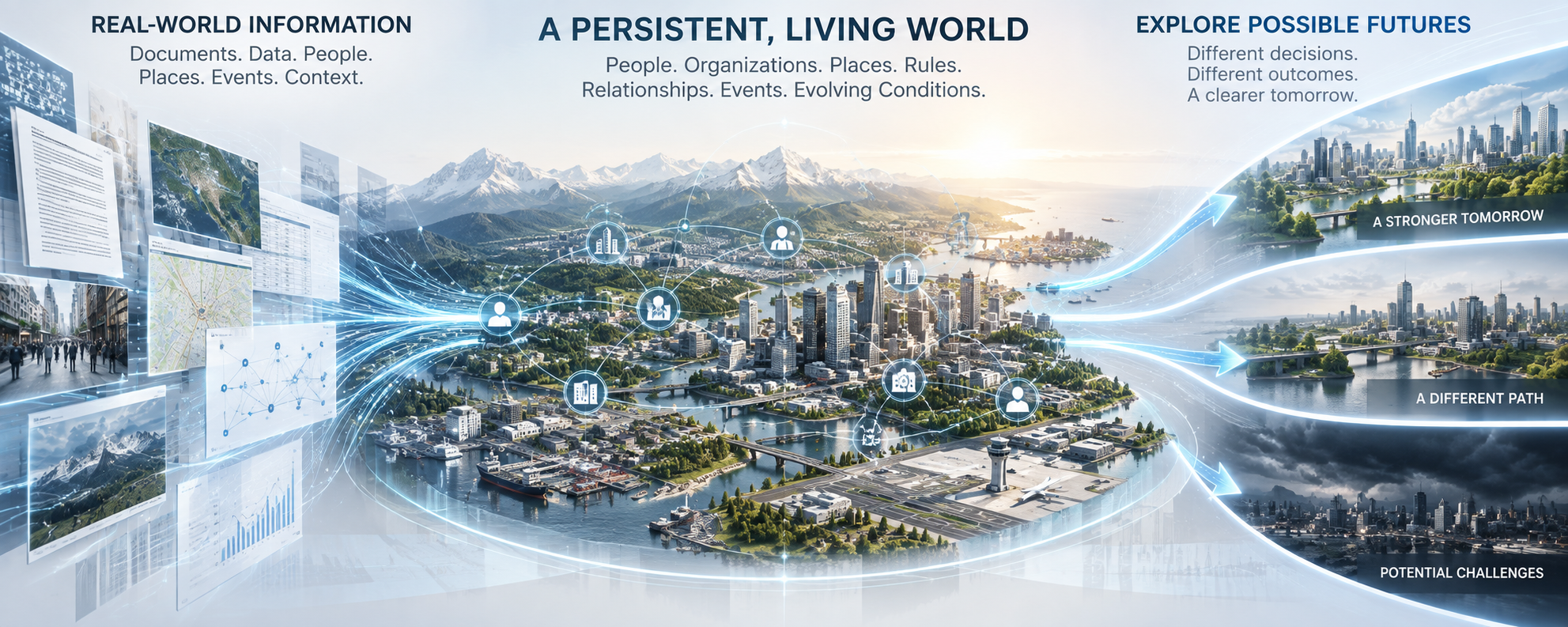
Generative AI can produce an answer to a prompt. A complex environment requires more: a durable representation of state, rules, actors, events, and consequences that remains coherent as people make decisions and conditions change.
Our technology portfolio provides that foundation for simulation, training, analysis, planning, decision support, and operational systems.
The technology thesis
Make persistence explicit.
State, memory, rules, relationships, events, and consequences are represented and maintained outside the generative model. This gives intelligent systems a source of truth that can be observed, tested, updated, and traced as the modeled environment changes.
The result is an architecture for long-running intelligence. The system does not need to reconstruct the world from prompt context each time it acts; it operates within a persistent environment whose current condition and history are available to the wider application.
The use-case may change completely. The need for continuity, causality, governing rules, and consequence does not.
Technology portfolio
A coordinated set of technology classes.
The classes below are complementary components of a broader architecture. They can be combined according to the environment, decision, workflow, or operating context being modeled.
| Technology class | Function | Operating value |
|---|---|---|
| Persistent world runtime | Maintains a durable, continuously evolving representation of people, organizations, places, relationships, events, resources, environmental conditions, and other world state across interactions and sessions. | The world persists and changes independently of any single prompt. |
| Rules and constraint intelligence | Represents and applies policies, permissions, procedures, resource limits, physical constraints, organizational requirements, geography, and other domain-specific rules. | Actions are evaluated against what is possible, permitted, valid, and consequential. |
| Actor and behavioral modeling | Represents actors with goals, incentives, knowledge, relationships, historical context, preferences, competing priorities, and perceptions. | Behavior reflects what actors know, want, believe, and have experienced. |
| Causal and consequence modeling | Represents chronology, dependencies, decisions, reactions, and downstream effects so the system can evaluate how events produce new conditions over time. | Understand not only what happened, but what it changes next. |
| Alternative-future simulation | Explores multiple possible outcomes from shared starting conditions while keeping different assumptions, decisions, strategies, and external events distinct. | Fork a situation, simulate different choices, and compare plausible futures. |
| Knowledge-to-world transformation | Transforms documents, structured data, imagery, spatial information, historical material, and other source information into interconnected models that can be explored and simulated. | Move from knowledge retrieval to knowledge simulation. |
| Multi-agent orchestration | Coordinates intelligent or simulated actors operating within one persistent environment, each with distinct roles, information, objectives, relationships, and permitted actions. | Multiple agents operate against shared world state rather than disconnected conversations. |
| Provenance and state traceability | Tracks where information originated, how modeled state changed, and whether information is sourced, inferred, simulated, or generated. | Preserve a traceable history from source information through evolving world state. |
Operating model
From knowledge to consequence.
Construct the environment
Source information becomes a structured world model containing entities, relationships, history, rules, resources, conditions, and assumptions.
Operate within the environment
Humans, simulated participants, and intelligent agents act against shared state. Rules and constraints determine what can occur, while actor behavior reflects goals, information, and history.
Explore what follows
Decisions produce consequences. The world changes, alternative scenarios can be compared, and the resulting state becomes the basis for subsequent action.
A coherent environment lets decision makers examine not only what may happen, but why it may happen and what may happen next.
Use cases
Applications across complex operating contexts.
The same underlying technologies can support different domains. Each use case draws on the portions of the portfolio appropriate to its environment, participants, and objectives.
Training and readiness
Persistent environments allow participants to practice decisions and interactions while the scenario responds to what they do.
- Simulation training Leadership development, emergency response, compliance, operational readiness, and professional certification.
- Customer service scenarios Multi-stage interactions shaped by customer history, expectations, emotional state, policy, and exceptions.
- Negotiation training Negotiations in which trust, leverage, concessions, beliefs, outside events, and prior statements continue to matter.
Analysis and forecasting
A modeled environment provides a structured way to examine actors, relationships, incentives, dependencies, and plausible responses.
- HUMINT analysis People, organizations, timelines, conflicting reports, uncertain motives, competing claims, and alternative hypotheses.
- Behavioral prediction Plausible actor responses under explicit assumptions about goals, incentives, information, and historical context.
- Risk forecasting Cascading risks emerging from interacting events, dependencies, people, infrastructure, policy, resources, and conditions.
Planning and decision support
Organizations can examine strategies and choices before action, with changing conditions and downstream effects in view.
- Scenario planning Alternative futures created by competitor actions, policy changes, demand shifts, supply disruptions, and external events.
- Decision support Assumptions, constraints, dependencies, and actor responses examined around a decision without replacing decision authority.
- Mission rehearsal Operational conditions, interactions, decisions, and consequences explored before a complex real-world operation.
Organizational and operational modeling
People, institutions, systems, processes, and resources can be modeled together to understand how local changes propagate.
- Crisis simulation Exercises that evolve as stakeholders, resources, information, and conditions change in response to participant actions.
- Synthetic societies Populations containing individuals, groups, institutions, relationships, incentives, and information flows.
- Workflow simulation Business processes containing people, systems, approvals, dependencies, queues, policies, and exceptions.
Knowledge and agent environments
Source material can become an interconnected environment in which specialized agents operate against common state.
- World-ingesting Source information transformed into connected entities, events, relationships, constraints, and contextual knowledge.
- Knowledge modeling Connected context across people, organizations, policies, events, and sources rather than isolated document fragments.
- Agent orchestration Specialized actors coordinated inside a shared environment with persistent consequences visible to other participants.
Responsible positioning
Human judgment remains essential.
These technologies are intended to expose possibilities, challenge assumptions, explore consequences, support training, and improve preparedness—not replace human decision authority.
Behavioral outputs are forecasts across plausible responses, not deterministic predictions. A simulation is only as useful as the assumptions, sources, constraints, and validation behind it.